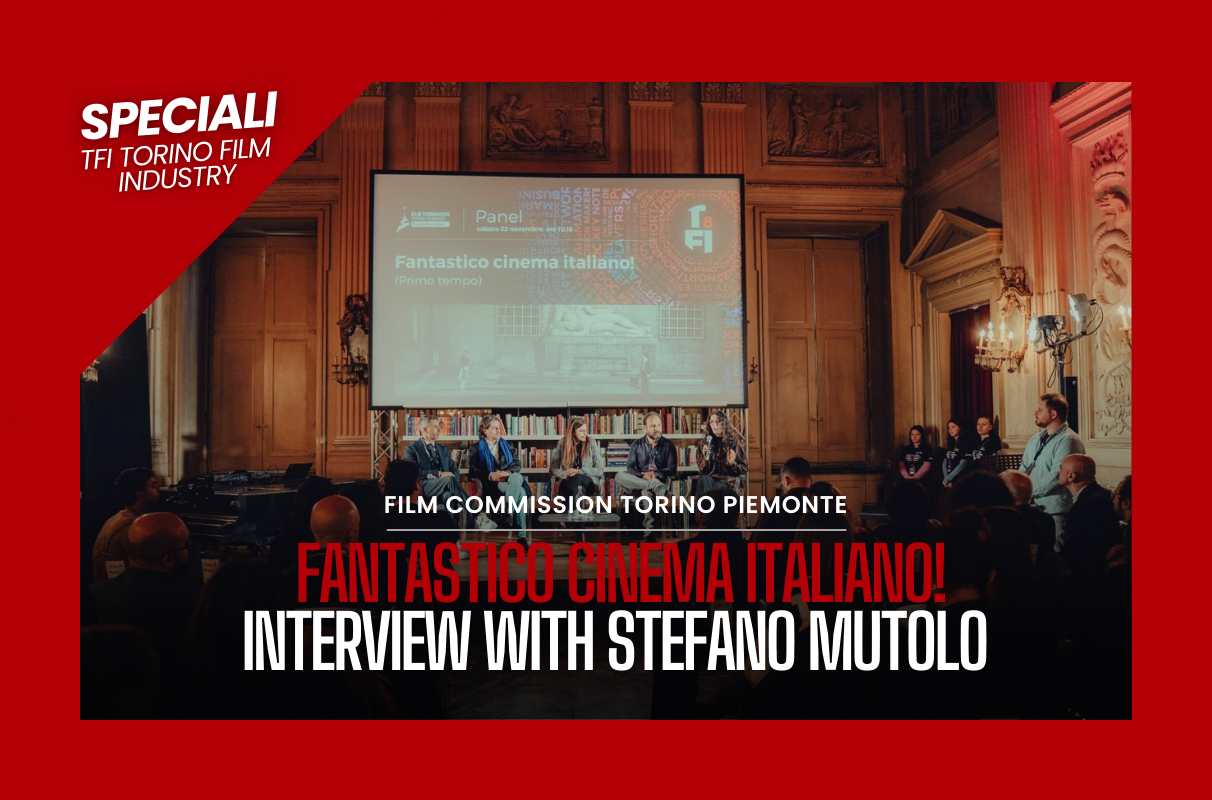
#10 TFI Specials | Fantastico cinema italiano! Interview with Stefano Mutolo
Dicembre 2025
"Let's talk about fantastic cinema: genre, horror, science fiction, fantasy. Let's talk about a world that is increasingly breaking out of its niche and engaging in dialogue with arthouse cinema, contemporary cinema and experimental cinema – something it has perhaps always done": this is how Paolo Manera introduced the morning dedicated to fantastic cinema, hosted at TFI Torino Film Industry 8 on Saturday 22 November 2025.
Divided into two acts, the stated goal of the day was to find and create a space where it would be possible to discuss content first and foremost, to ask what there is to tell and what the state of the art is today, as well as infrastructure and production attitudes, in order to outline, on the one hand, the imagery of Italian fantastico and, on the other, to sketch its expression in the industry.
The event was organised in close collaboration with CNA Cinema & Audiovisivo Piemonte and Derry Social Club – a network created by Stefano Mutolo, founder and producer for Berta Film, with the aim of creating discussion, planning and synergies between authors, producers, professionals and new voices, in order to achieve the necessary cohesion to support the rebirth of the fantastico industry.
This seems to be a moment of convergence of intent between creators and institutions, which has resulted in the presence on stage at the Circolo dei lettori e delle lettrici of representatives at all levels: the 'talents' included directors Martina Girlanda, Eugenio Villani, Maurizio Matteo Merli and Paolo Gep Cucco, along with screenwriter Simona Nobile, moderated by author and screenwriter Lucio Besana; Elettra Canovi for HBO Max Italia, Giorgia Priolo for EDI Effetti Digitali Italiani, screenwriters Jacopo Del Giudice and Alessandro Regaldo, together with Alessia Gasparella and Massimiliano Supporta from TOHorror Fantastic Film Fest, were called upon to represent the industry; at the end of the speeches, after listening to the discussion, representatives of the institutions also took the floor, in the persons of Marina Chiarelli (Councillor for Culture, Equal Opportunities and Youth Policies for Regione Piemonte), Gianluca Curti (President of CNA Cinema & Audiovisivo Italia), Mattia Puleo (President of CNA Cinema & Audiovisivo Piemonte), Steve Della Casa (Curator SC - Cineteca Nazionale) and Hon. Federico Mollicone (President of the Chamber of Deputies' Culture Committee), who presented a proposal during the last Venice International Film Festival for an enabling act for the government to strengthen the film and audiovisual sector, with particular attention to the introduction of a line dedicated to genre films.
To summarise the results of the meeting, this month's TFI Special features Stefano Mutolo, who provides details on genre cinema, what the presence in Torino meant and the near future of both 'Fantastico Cinema' and, particularly, 'Fantastico Cinema Italiano'.
_______________________
Let's start from the beginning: what are we talking about when we talk about genre cinema?
When we talk about genre cinema, we are not talking about a cage, but a language. Genre is a pact with the viewer: horror, thriller, science fiction, fantasy and crime promise a precise, codified emotional experience, but anything can enter into that pact. Authorship, political discourse, intimacy, experimentation. Historically, genre has always been the place where cinema has been able to take the most risks, because it masked the risk in recognisable forms. Today, more than ever, it is a tool for telling the story of the present in an oblique but powerful way.
How did the Derry Social Club come about? Was there a particular convergence between institutional attention and the creation of the network?
The Derry Social Club was born in a very concrete and not very theoretical way: from conversations between professionals who were already working in genre cinema and who felt the lack of a common space for discussion. The debut at TFI Torino Film Industry with the panel 'Fantastico Cinema Italiano' gave shape to this need, transforming it into an active, project-based, non-nostalgic network. It is true that there is renewed institutional attention towards the genre today, and this has certainly created a favourable context. But the DSC was not created in response to a policy: it was created from the bottom up, and if anything, it is now seeking a mature dialogue with institutions, bringing ideas, projects and vision. To date, we already have over 70 members, including companies and professionals.
What are the major references in genre cinema and where can we find them today?
In the preparatory work for the panel, a clear awareness emerged: today, genre cinema is a transnational ecosystem, made up of continuous dialogue between different cinematographies, rather than isolated models. We look abroad a lot, not for imitation, but because genre has been systematically valued there.
In France, the reference point is the so-called New French Extremity, which has shown how genre can be radical and auteur-driven while at the same time supported by an industrial and institutional system. In Scandinavia, horror and thriller films have found a strong identity through their intertwining with social and psychological drama in Nordic Noir. In Spain, the genre has become a real industrial engine, capable of producing popular and exportable films, especially in the horror genre. Finally, in the United States, the genre has always been a space for continuous experimentation, now renewed by a strong focus on political and identity discourse, moving between mainstream, elevated genre and indie.
In Italy, the discourse has historically been more fragmented. One very clear fact that emerged during the panel discussion was that the only genre that has taken root with any consistency is crime series, which have been able to build a stable relationship with television audiences and platforms. Genre cinema, on the other hand, has proceeded in fits and starts, with symbolic films.
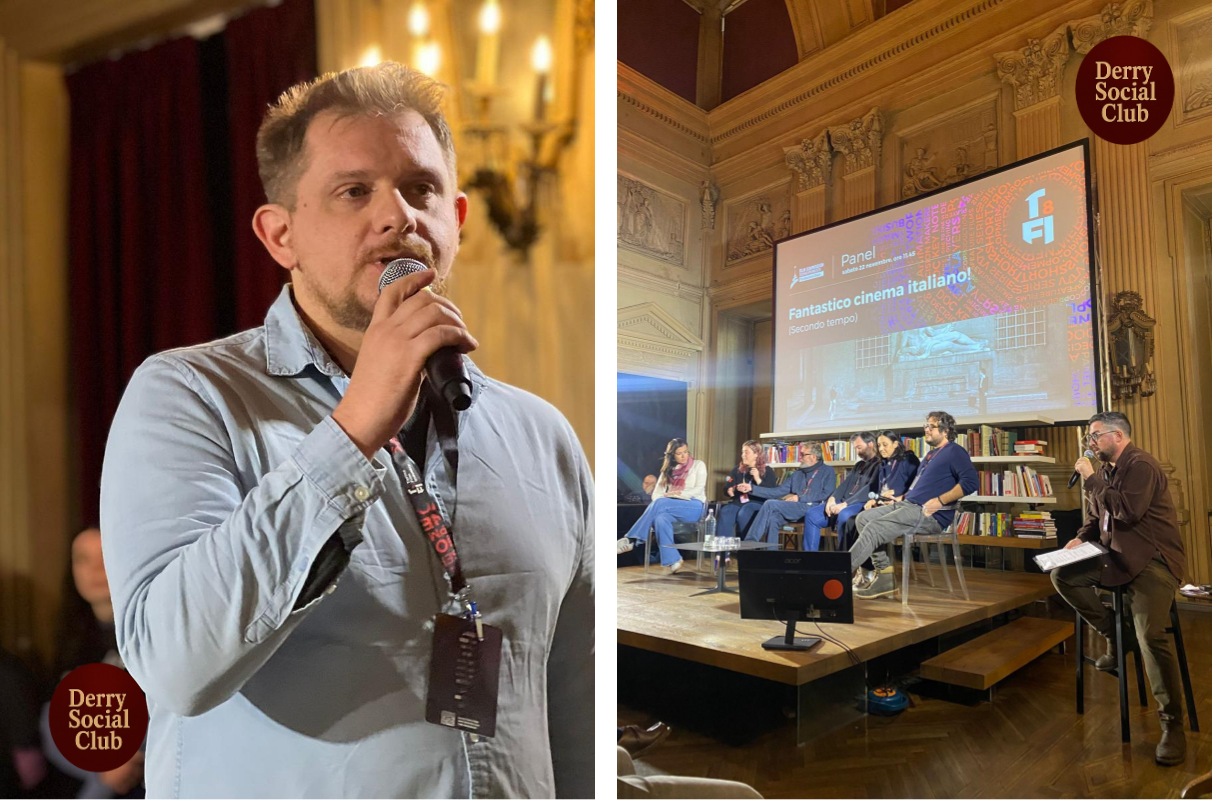
Pictured, left: Lucio Besana. Pictured, right: second part panelists, hosted by Stefano Mutolo (right)
In my opinion, the first real contemporary watershed moment was “Lo chiamavano Jeeg Robot”, which proved that an Italian genre film could win over audiences, box offices and critics alike, even winning the most prestigious awards. Not so much for the superhero himself, but for the idea that the genre could be both deeply popular and deeply Italian at the same time.
From then on, an underground but extremely fertile season began. I am thinking of the work of Paolo Strippoli, with films such as “Piove”, “A Classic Horror Story” (co-directed with Roberto De Feo) and “La Valle dei Sorrisi” (selected in Venice, distributed in Italy by Vision Distribution and abroad by Shudder), capable of combining horror, landscape and contemporary unease; the more mainstream genre films of Vincenzo Alfieri, Matteo Rovere, Donato Carrisi, and Andrea di Stefano; the more auteur films of Matteo Garrone (“Il racconto dei racconti”, “Pinocchio”, “Dogman”); the films of Ambra Principato, which have taken the genre to a more intimate and disturbing dimension; and the latest works by Gabriele Mainetti, which continue to question the relationship between spectacle, identity, and audience.
Screenwriters such as Lucio Besana and Jacopo Del Giudice have also played a fundamental role, helping to construct a credible contemporary genre imagery, as have more radical figures such as Marco Ristori and Luca Boni, who are active on a more underground and independent front. Alongside them, new voices such as Vera Berniotto and Lea Berniotto, or the work of Federico Zampaglione, in its most radical and indie forms, paint a much richer picture than is often perceived from the outside.
I would like to and should mention many others, but this is just to give an idea. And let us remember that behind these authors there is a constellation of production and distribution companies (above all Plaion with Midnight Factory, specialising in horror), VFX and craftsmen of all kinds. Not to mention the specialised press that gives voice to genre cinema, above all Nocturno, as well as more generalist publications such as FilmTv, Cinefacts and Ciak.
The central point that emerged strongly in the panel is that there is a large hidden part: mainstream and underground authors and producers who work in the genre without a system that truly connects them. This is one of the reasons why the Derry Social Club was created: not to create a new label, but to recognise, promote and systematise an existing heritage, so that Italian genre cinema can finally be seen as a living entity and not as a series of lucky exceptions.
What were the expectations for the panel at TFI Torino Film Industry?
The aim of the 'Fantastico Cinema Italiano' panel was very clear: to create a space for listening and alignment. To bring together talent, producers and institutions to take stock of the state of the art of genre cinema in Italy, without triumphalism but also without inferiority complexes. It was the public debut of the Derry Social Club, so we didn't want to 'present a manifesto', but to start a credible conversation in an industrial context.
And in hindsight, was it achieved?
Yes, to the extent that a panel can be considered a success not for the applause but for the consequences. Dialogues were opened, common needs were recognised, and concrete possibilities for future collaboration emerged, from training to editorial and production projects. It is not a definitive result, but it is a real first step, which was exactly the goal.
The panel divided into categories suggests a balance of roles: are we in a moment of agreement?
We are in an interesting moment, rather than a 'happy' one. Genre cinema only works if investment, talent and institutional context are in tune with each other. Today, this dialogue is possible, but not automatic. Mutual awareness is needed: investors must accept a share of the risk, creators must also think in industrial terms, and regulators must understand the specificities of the genre. The panel showed that this alignment is not an utopia, but a task to be accomplished with patience.
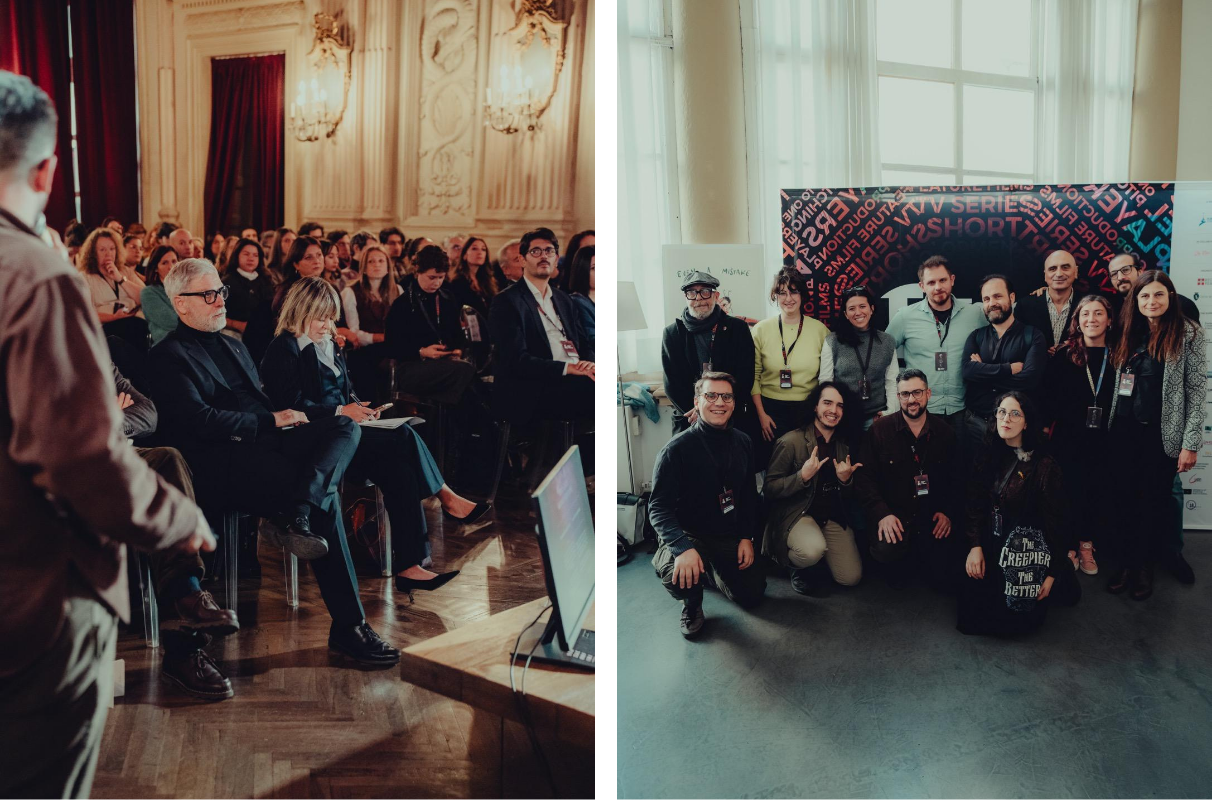
Pictured, left: on. Federico Mollicone, Marina Chiarelli, Mattia Puleo. Pictured, right: “Fantastico cinema italiano!” panelists
A question about audiences and critics: how are genre films doing today?
The genre communicates very well with the public, often better than other more 'prestigious' areas, especially when it finds consistent distribution channels. Series have played a huge role in bringing the general public back to fantasy, just think of “Stranger Things”, which has shown how the genre can be both popular and sophisticated. In cinema, the path is more complex, but when a film finds a clear proposal and honest communication, the response comes. This can be seen in box office figures and industry analyses, although it varies from case to case.
But is it 'Fantastico Cinema Italiano'?
This is a crucial question. It is not just a matter of reviving a B-movie identity in a nostalgic sense, even though Italian tradition is an enormous heritage. Today's challenge is broader: to use the genre to tell Italian stories that also speak beyond borders. Italian not as a formal label, but as a perspective. In this sense, the genre becomes a tool for internationalisation, not closure.
What actions can the industry take for continuous development?
The actions are concrete: specific training on the genre, support for development, production continuity, spaces for discussion such as those that the Derry Social Club is trying to build. But above all, a medium-term vision is needed: to stop considering the genre as an exception and start treating it as a structural component of the audiovisual ecosystem. This requires time, trust and alliances. It is an ongoing process, not a ready-made formula.
The day when, faced with a good Italian film or series, the audience stops saying 'it's good, for an Italian film', then it will mean that Italian fantasy cinema has truly regained momentum and, above all, an audience.