#12 TFI Specials | The videoclip. From idea to screen
Febbraio 2026
TFI Torino Film Industry 8 saw for the first time the structured participation of Seeyousound International Music Film Festival, the Torino festival dedicated to the encounter between music and cinema. Thanks to this collaboration, we organized a panel dedicated to the videoclip, moderated by SYS Deputy Director Alessandro Battaglini and with the presence of Marco Gallorini for Woodmorm Group, Matteo Stefani for Borotalco TV and Andrea Settembrini from the collective director Broga's, representing the different artistic and productive areas that meet in the creation of a videoclip.
The panel was an opportunity for discussion designed to provide a gateway to the public of TFI Torino Film Industry in a niche of the audiovisual sector that increasingly defines itself as a fundamental space for experimenting and defining new audiovisual languages for the way it manages to put music and cinema in dialogue with the major new media communication tools. Gallorini, Stefani and Settembrini have long confronted on the industrial conditions that lead to the birth of the videoclip, examining how industrial needs must be compared with creative ones at different points in the supply chain - starting from the internal phase of the record company and the definition of the budget, through production that acts as a link between music and audiovisual, up to the direction, which works to adapt the musical artistic idea to the syntax and language of images.
Seeyousound International Music Film Festival comes back to Torino from 3 to 8 March with its 12th edition, one week after the 76th edition of the Sanremo Festival, the indisputably most important moment for the Italian music industry. Given this convergence, we contacted the participants of the panel to ask them for a return of the Torino moment, regarding new possibilities and horizons. The result was a long conversation between Gallorini, Settembrini and Battaglini, which we publish in full in the Special to preserve their spontaneity.
Closing up, a comment by Matteo Stefani that concludes the harmony of the world sphere videoclip.
Let’s start with the meeting: how was the experience of TFI? Did it bring you new exchanges? Was it a moment of certification for the relevance of the videoclip object in the audiovisual framework?
Marco Gallorini (Woodworm Group)
Co-CEO of Woodworm, an independent music company based in Arezzo founded at the beginning of 2011 with the aim of becoming a reality operating in all sectors of the musical "supply chain". Woodworm includes an independent label, a dedicated management team and an editorial team.
In practical terms, for me it was useful because I brought home from the meeting some new contacts. We’ve also synced some tracks, so for me it’s just great - call me again, I’ll be back! I really made new contacts with some female directors, with the production, it was a very interesting work opportunity. And the conversation we had then gave me the opportunity to also compare myself with my boys for a reflection on the specific videoclip, as we did. It’s usually difficult, it’s an element that you lose a bit of sight: and instead it was useful internally, because every time we have meetings so then we give feedback in the company, and basically we took up the topic of having to work with creatives, with the directors, then with those who make the content together with the artist, trying to bring home an idea of videoclips and also content assets.
A storytelling that can also start from the videoclip, which then has to be expanded on content assets, which for us are now fundamental to communicate in this way, say, 3.0. So for me it was really useful, from both points of view, and to have met some good people never hurts.
Andrea Settembrini (Broga's)
Director part of the collective Broga's with Francesco Lorusso and Gabriele Licchelli, a workshop of ideas and images, a space of thought and action on cinema and audiovisual that has as its leitmotif to go beyond any kind of boundary - geographical and ideal, understood as the boundary that separates reality from representation, seeking with a new perspective a poetic insight into the world.
From my point of view it was a useful meeting, even if in terms of work response it has not changed much, but certainly it was useful to confront with other people who do these things and with the people working on the other side, that is, those who make music, to have an exchange. Because very often in our work we do things, but there is no time then to reflect on what has been done. It was definitely a moment when you were forced to say ok, let’s reflect on what we have done so far. Not an all-encompassing reflection, but at least a space for reflection, which in my opinion there is less and less in this very fast world. This thing perhaps does not give a result in the short term, but in my opinion in the long run it allows to trigger reflections, reasoning that then maybe at some point will lead to something, both at the level of perception of what is done, and then in concrete terms.
In my opinion, the fact that TFI Torino Film Industry has a space and a moment dedicated to the videoclip gives dignity to this form of art and audiovisual, which, on the other hand, is always a bit grumbled and considered something that second-class workers do, or for those who have just entered this sector. Instead, this gave the perception of something that must be done like all other things, well done. Even the fact that Film Commission Torino Piemonte is always very active in supporting and encouraging this type of production on the territory, is not a trivial thing at all.
Alessandro Battaglini (Seeyousound International Music Film Festival)
Deputy Artistic Director of Seeyousound International Music Film Festival, the unmistakable mix of music and cinema that celebrates in 7 days of programming in Torino the union of stories and images of characters and currents, in background or protagonists of moments or entire lives.
I welcome and agree with all the arguments. From my point of view, someone who is not involved in a productive/musical relationship, but in festivals and videoclips enthusiasts - I have always interpreted the videoclip as a fundamental language of audiovisual production. A panel like ours is a starting point. One thing we have done with the festival since the first edition is to implement the videoclip section, which is a very important section that leads to spaces that are not only cinema. I hope this is the beginning of a process that will continue in the coming years by activating virtuous paths, which can start from this panel.
I dream, but I hope in a space where there can be pitches, where there can be an even larger, more creative and productive exchange. In other European countries it has already been shown that the videoclip is a market that can go on and that can create another type of market both from an artistic and economic point of view. In Italy, there are very few companies that have given the right importance to videoclips in recent years, even as part of the decision to invest in the creative process.
It is always very difficult to include an Italian videoclip in our international competitions. Not because there are no good filmmakers; is that the record companies see the videoclip a bit like a remnant of budget and treat it without giving it the right creative importance. The work we did on the panel was also to activate connections with those in the area who are active in a different way, both at the level of recording and production. I would like this connection to continue in a more specific and continuous way, that is that a virtuous activity is not an exception but part of a process increasingly normalized to expand the possibilities of videoclips within musical storytelling.
Marco Gallorini
You know, these days I was talking about a guy that I really like and he’s coming out right now. The interesting thing is that his management comes from fashion, so there is hyper-attention to the aesthetic factor. With the record company that follows him, we said that with some thought behind it, the budget then is there. He had made a videoclip quite simple, but really cool, really cool, with a study of everything in detail.
So the problem is a bit of an approach to things. If the videoclip has to be made by force, sometimes it dies a bit there. But if it harmonizes in a process...
Alessandro Battaglini
In 2018 in O.G.R. we gave some lectures on the videoclip, and Collettivo Canada came and told me that the first video they made was for a Catalan group singing in Catalan, and it cost 1,200 euros with a completely homemade process. But there was a strong idea, a process of exchange with the artist. Precisely, it’s not a matter of budget: then the ideas are found, and the point is to return an aesthetic imagery and be able to combine an incredibly powerful tool like video, with an aesthetic imagery of an artist who has so much to say and propose.
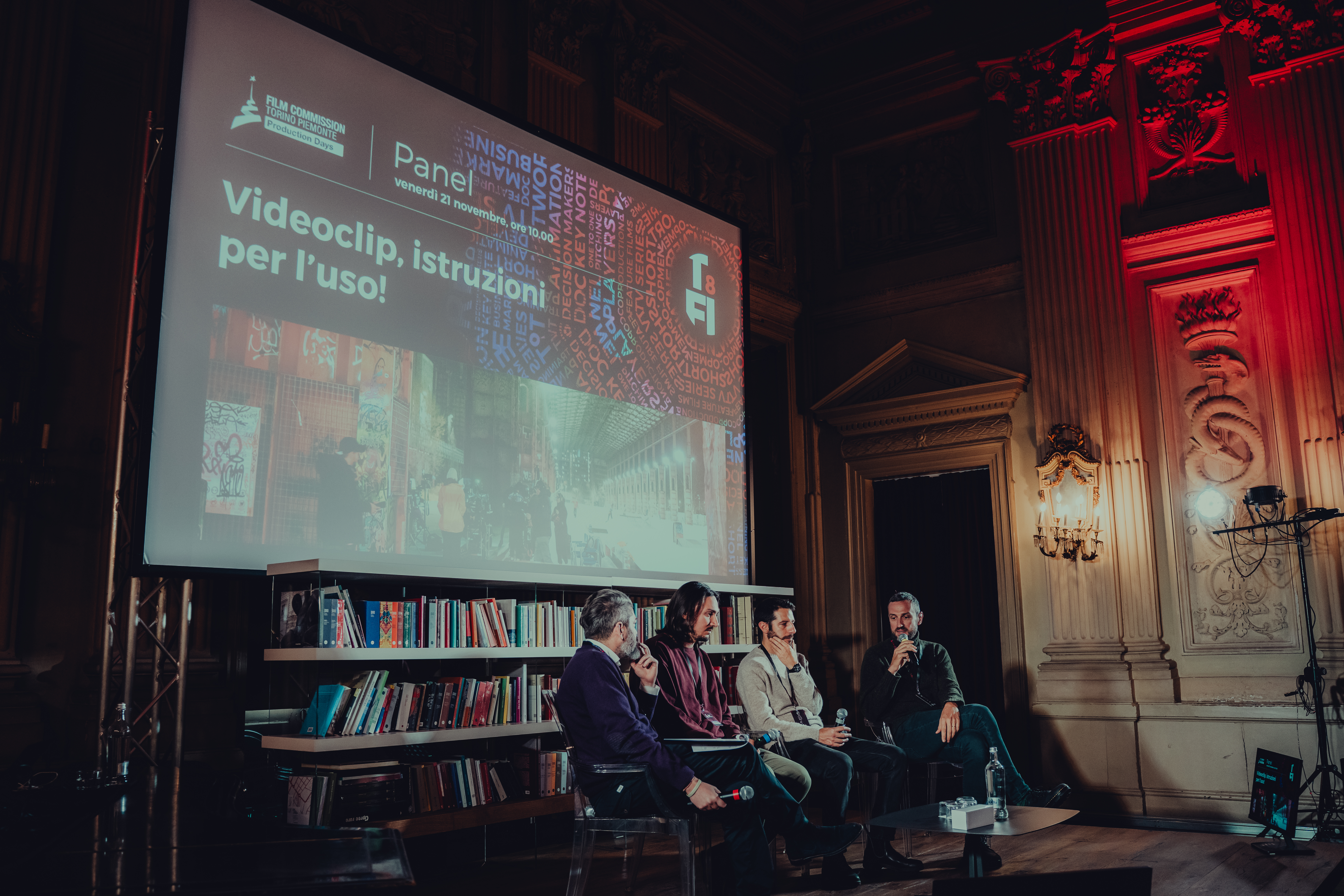
From left: Alessandro Battaglini (Seeyousound International Music Film Festival), Andrea Settembrini (Broga's), Matteo Stefani (Borotalco TV), Matteo Gallorini (Wooodworm Group).
Do you think there is an inherent difficulty in the need to join two industries? The audiovisual and the musical ones that must speak to each other.
Marco Gallorini
In my opinion, there must be the will to start, which goes from those who produce the record. If I’m a recording artist, I have to be careful how I get into creativity.
Andrea Settembrini
It’s a matter of approach. If in a homogeneous and consistent way with what is the design of an artist, obviously the products that result are not superficial. We believe in this thing very much. Like Broga’s we made videos with 2-3 thousand euros which for me are more beautiful than the videos we did with ten times the budget. It’s just a matter of intention.
We are talking about forms of expression that have to communicate something. If we start with "we have to say this thing", "we have to make it look like this", "it has to go with the music in that other way", then the intentions are clear and the approach you have on things is vertical, thorough, and curated. Sometimes it’s also the fault of the filmmakers, I make a mea culpa: we don’t go deep and instead move on to already seen references because it’s easier, and the video will probably come out visually beautiful but then doesn’t add anything to the song or the artist’s communication. Regardless of the budget, there are solutions: if we have 2,000 euros, then we know that we have to move with certain means, but you can still do some beautiful things.
What is the positioning of Italy compared to the international context? Are there virtuous examples to follow?
Alessandro Battaglini
The cultural base in Italy is totally lacking. As a selector, I can say that at the moment Spain has an edge. The Collettivo Canada has objectively changed history: it is a collective that has given possibilities and that has created, as happens in cinema, aesthetic schools. The UK continues to play a central role, because there is also a very diverse and more open music culture. France also has some interesting things, and lately Poland is doing some very nice things. Before the war with Ukraine also from Russia - it was objectively a very powerful source of inspiration from which came hyper weird, aesthetically sublime.
South Korea is now also pushing hard. There they push a lot on the very American-like videoclips.
In the panel you mentioned at the beginning MTV that since 1981 is an essential passage to talk about the existence of the videoclip. We are talking about a television channel: the literal screen is that of the television, which is a different medium compared to the movie screen.
Alessandro Battaglini
We brought them to the cinema screen first! I take paternity. In the early years we brought a music video of a Dutch band, "Witch Doctor" by De Staat, which was then voted the most important video in the history of Dutch music. Before the films at the festival we always show a videoclip to give it more audience visibility: I still remember that when we showed this there was the spontaneous applause of a completely full room. Finally, the size of the television screen, which is now a computer screen, had also been removed somewhat, bringing it to a new frontier of viewing that was that of cinema.
It was an image I already had when I followed them on MTV at the time: it was already a frontier that was going to break the screen. I had not been abroad in my life, and the music video was my window on the world. With MTV Europe, there was an idea of a united Europe that reached us directly at home from all parts of Europe. For me, Enrico Silvestrin was a national pride.
It also cost much more, a video of Janet Jackson could cost more than a film. Even then it was the major promotional tool, pushing for any sale.
Once I managed to get an agreement with Universal that gave me the okay to do the white night of the videos. The first time I saw "Bedtime Story" by Madonna on a cinema screen, 8 meters, with 5.1 audio, in high quality, I started to cry. I would like to think of a room size where the videoclip is always shown before the film, even when we go to the cinema normally.
Matteo Stefani (Borotalco TV)
Owner and executive producer of Borotalco TV, a company producing music videos, branded content, television formats, advertisements, films and documentaries. Based in Rome and Milan, they work 360° with national and international partners to develop the best creative solutions for new media communication.
I wanted to share some thoughts about the meeting we had at TFI Torino Film Industry. As far as I’m concerned, it was a really very positive experience. First of all for the people you know and the new contacts created. Apart from Andrea Settembrini of the Broga, whom I already knew and highly respected - it was still a pleasure to be able to talk calmly - I found the dialogue with all the other participants extremely enriching. Even just the possibility to break away for a moment from the work routine, which for us is always very fast, has been valuable. In this sense, the atmosphere, welcome and format of the meeting certainly made a difference.
From a more professional perspective, it was interesting to discuss different approaches and viewpoints. We work for 80-90% in a very "industrial" dimension, linked to the needs of majors and artists: often the videoclip does not arise from the request of a great creative idea, but from the need to respond to a communication strategy or an already defined aesthetic. It is our job and that is right: we are at the service of projects and we must propose the best possible solutions, compatible with the requests and constraints given to us.
Precisely for this reason, the discussion in Torino was stimulating, because it allowed us to talk about videoclips on a more artistic level, focusing on aspects that often take a back seat in everyday work. When you meet artists, managers, and labels who are more sensitive to the creative dimension, very interesting possibilities open up, even without huge budgets.
Also connecting to the Sanremo period – for which we made several music videos – it's clear that, among many works, there are some that stand out every year because there was the opportunity to develop a stronger and more structured idea. Much depends on how central the artist considers the videoclip to his project: some see it as a fundamental element and others as a simple support. Among this year's works, I particularly highlight the video of Marie Antoinette and Colombre, directed by Danilo Bubani, which we created using various techniques –from stop motion to VFX, up to traditional filming– and which was set almost entirely inside the Museo Nazionale del Rinascimento di Torino. I also wanted to mention this because the Film Commission Torino Piemonte, along with the one in Milan with which we work most often, is one of the organizations that has supported us most in recent years, always demonstrating its commitment to valuable projects.
Among the music videos for the songs competing at the 76° Sanremo Festival is also “Sei tu” by Levante, directed by Broga's and realized with the support of Film Commission Torino Piemonte.
Seeyousound International Music Film Festival returns to Torino March 3-8, 2026. For more information: seeyousound.org