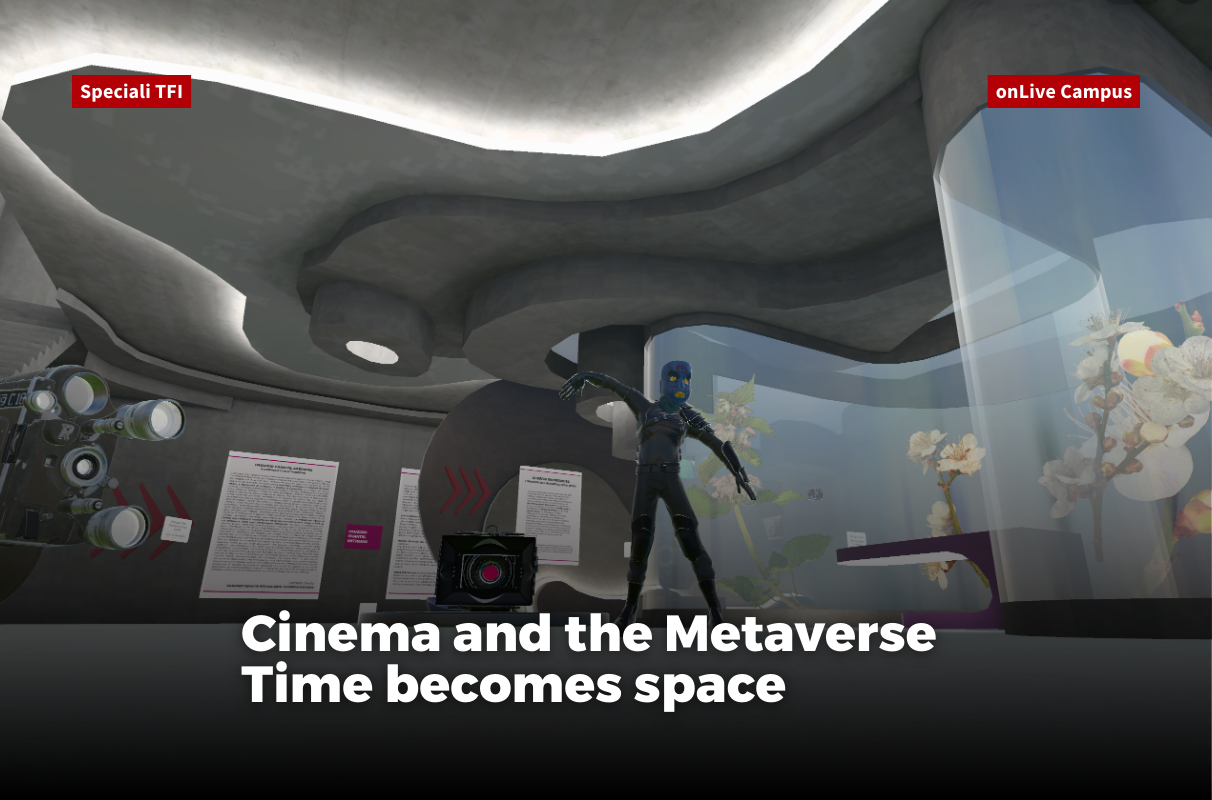
#13 TFI Specials | Cinema and the Metaverse: time becomes space
Marzo 2026
The boundary between historical archive and future experimentation is fluid: from 19 to 21 March 2026, the digital city envisioned by the VERSE project – Creating Networks in the Metaverse hosts NEXT STAGE – VERSE Festival for Arts in the Metaverse, a festival that transforms the metaverse into a vibrant and participatory “city of the arts”.
Among the scheduled events, a profound reflection on time and cinematic language. As the centrepiece of the day on 19 March, the event ‘Sguardi in progress’ reopens the archive of the Sguardi Altrove Women’s International Film Festival, creating an unexpected bridge between 2016 and 2026.
Thanks to Fondazione Piemonte dal Vivo’s onLive, we interviewed Susanna Bandi, Stefano Conca Bonizzoni and Lorenza Sacco (Officine Creative - Università di Pavia), to hear how the metaverse can become a paradoxical tool: not a place of rapid consumption, nor merely a record, but an immersive device that offers space to slow down and deepen one’s viewing, transforming the spectator from a passive observer into an “active presence” within the narrative: the metaverse avoids the showcase effect, shifting the focus from a mere celebration of the past to its reintroduction into circulation as an ongoing process.
From the rediscovery of Turkish cinema and human rights to the centrality of Chantal Akerman — now enshrined in the canon yet still capable of challenging conventions — NEXT STAGE invites us to cross a threshold where cinema is not merely to be watched, but demands to be traversed.
Where did the idea of linking 2016 and 2026 come from? Is there any connection with the recent nostalgic revival of 2016?
The idea arose from working directly with the archive of the Sguardi Altrove Women’s International Film Festival, not from a nostalgic impulse. Looking back at the material from 2016, we realised that many issues we now perceive as urgent were already there, but in a form still in the making. The nostalgic revival of 2016, which is seen today mainly online, tends to present a cohesive and reassuring image of that year. Our work does almost the opposite: it does not reconstruct 2016 as an ‘era’, but reopens it as a process. In this sense, the metaverse serves precisely to avoid the ‘showcase’ effect: we do not celebrate that edition; we put it back into circulation, making it traversable once more through a dialogic device at a time when the word ‘digital’ is often associated with rapid, overstimulated consumption. Our idea, on the contrary, is to try to use the metaverse to slow down, to deepen our vision and to connect different times.
Why 2016 specifically? Is it a starting point or a finishing point?
2016 marks a turning point in the festival’s history where certain themes were already very clear: the focus on rights, the attention to non-Western cinema, and a profound reflection on filmmakers such as Chantal Akerman. It is not a ‘legendary’ year, but a point where these trajectories become visible. Looking back from 2026, it becomes interesting because it allows us to understand what has truly changed and what, on the other hand, has remained unresolved. More than an origin or a conclusion, it is a threshold that we can now revisit with greater awareness. The metaverse allows us to work precisely on this temporal threshold: not simply to rewatch films, but to revisit them in the light of what has happened over these ten years—profound transformations, but also surprising continuities.
What similarities and differences emerge between the two years?
The most obvious thing is that the themes have remained: rights, representation, the geographies of cinema. They haven’t disappeared; on the contrary, they have become more complex and, in some cases, more urgent.
What has changed is the way we engage with them. In 2016, many films drew their power from their role as testimony, from the need to bring certain stories to light. In 2026, without losing this dimension, there is a greater focus on language and form: cinema does not merely tell stories, but questions how it tells them, and often steps off the screen, entering installation-based or immersive spaces such as this one.
What traces of 2016 can be found in 2026? Does cinema reflect on itself?
In 2026 we find many of the insights from 2016, but transformed. Some have become established, others have become more radical, and still others have faded away.
Certainly, reflection on the medium is more evident today. The cinema we see today, even within the festival, is more aware of its own limits and plays with them, often blending with other forms of expression. The transition to the metaverse therefore does not arise as a break, but as an extension of this trend: bringing cinema into a space where it can be experienced, not just watched.
How much can the experience of works from another era change when mediated by new technologies?
New technologies do not so much change the work itself as the context in which it is experienced. An audiovisual work created for a screen can become part of an immersive space, where the viewer is no longer merely an observer but an active presence. This allows us to rediscover recent works with a fresh perspective, relating them to new environments and modes of participation.
How do the different media interact with one another in the construction of this experience?
The experience arises from the convergence of different languages: virtual architecture, audiovisual media, interaction and the performative dimension. The space within the metaverse structures the journey and suggests relationships between the works, whilst the videos and short films form the narrative core. Added to this is the presence of users and guided moments, which transform viewing into a shared experience.
How was the event on 19 March structured?
The event on 19 March takes the form of a guided tour of the exhibition “Sguardi in progress: the archive in the metaverse (2016–2026)”, which revisits and reinterprets the 2016 edition of the Sguardi Altrove Women’s International Film Festival. The journey through the metaverse reinterprets that programme ten years on, reviving three central themes: human rights, the filmography of Chantal Akerman and a focus on Turkish cinema.
During the live event, the audience takes part in a guided tour of the exhibition spaces and the virtual auditorium, where archive materials, images and texts create an immersive journey through time. The experience concludes with a screening of Marta Massa’s short film The Trials (2025), establishing a dialogue between the festival archive and a contemporary perspective. The aim is to transform the archive into a space to be explored, where the past is reinterpreted through the technologies and sensibilities of the present.
How is the way we engage with an audience changing through experiences that bring together audiovisual media and the performing arts?
Immersive technologies are transforming the audience from spectators into participants. When audiovisual media and the performing arts meet in shared digital environments, the narrative no longer passes solely through a screen but through a space to be traversed. This opens up new narrative possibilities and creates more collective and interactive forms of engagement.
In 2016, would anyone have thought that Akerman could climb the Sight & Sound rankings as the director of the greatest film of all time, “Jeanne Dielman, 23, quai du Commerce, 1080 Brussels”, as happened in 2022? In 2026, do we view this recognition as something ‘normal’, or do we still perceive the powerful sense of novelty and surprise it brings?
In 2016, it would have been difficult to imagine that “Jeanne Dielman, 23, quai du Commerce, 1080 Brussels” could become the “best film of all time” according to Sight & Sound. Although already considered seminal by some critics, Chantal Akerman’s work was often perceived as radical and marginal: an austere, slow-paced film, appreciated mainly among cinephiles and far removed from the mainstream canon. Precisely for this reason, its top spot in the 2022 ranking represented a clear break with tradition. Today, in 2026, this break has been partly absorbed, but not entirely. The film is undoubtedly more central than in the past: it is discussed, studied and rediscovered even by new generations of viewers, and its importance appears increasingly evident in the history of cinema. In this sense, its top ranking has initiated a process of ‘normalisation’, entering a broader and more inclusive canon. Nevertheless, it continues to retain a strong sense of novelty and surprise: Jeanne Dielman remains, in fact, a radical and demanding work, capable of testing the viewer and still challenging narrative and visual conventions today.
VERSE is a project funded under the PNRR – NextGenerationEU and realized by Fondazione LINKS, Fondazione Piemonte dal Vivo and AssociAnimazione.